ARTICLE 06 OF 06
Medical Power of Attorney and Legal Preparedness for NRI Families in India
Healthcare decisions cannot wait for an international flight. Without the right documents in place, even well-intentioned family members may face institutional barriers in a medical emergency.
Reading time: 6 minutes · Legal Preparedness
What Medical Power of Attorney Is
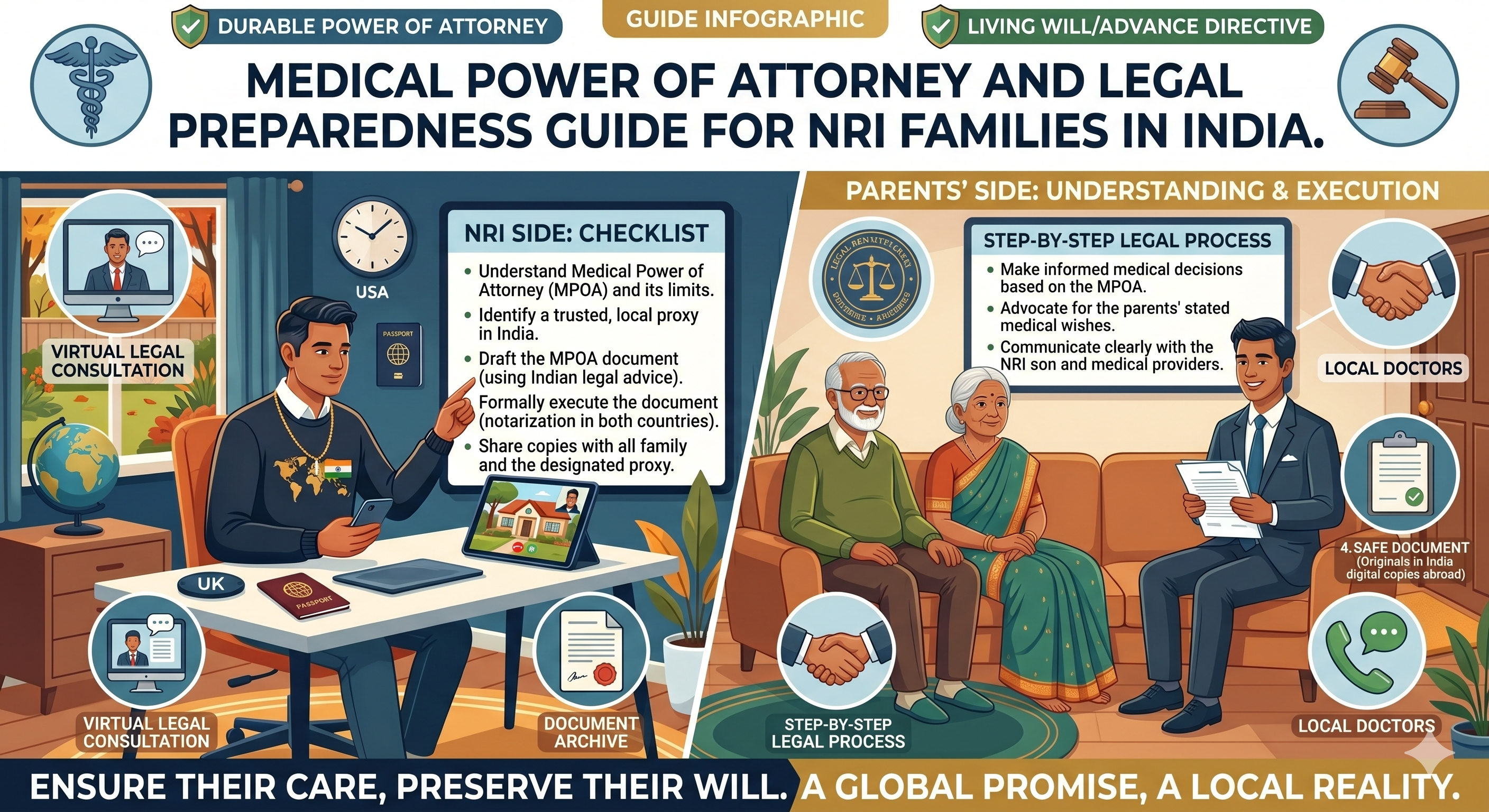
Medical Power of Attorney (MPoA) is a legal document that authorises a designated person to make healthcare decisions on behalf of an elderly parent if they become incapable of doing so — due to a stroke, loss of consciousness, severe cognitive decline, or any other incapacitating condition.
In India’s healthcare system, hospitals typically require consent from immediate family members or a legally appointed representative before proceeding with significant treatment decisions. Without proper documentation, NRI children who are the primary decision-makers may face delays even when they hold full financial responsibility.
Why This Matters Specifically for NRI Families
Hospital protocols vary across Indian cities. Some facilities accept verbal consent from multiple family members. Others insist on written legal authority before proceeding with surgery, intensive care admission, or organ donation decisions. When the primary decision-maker cannot travel for days, this inconsistency becomes a serious problem.
How to Establish MPoA in India
Medical Power of Attorney in India is governed by the Indian Succession Act, 1925, and relevant state-specific legislation. The practical steps:
- Create the document naming the attorney-in-fact. Include specific powers: consent to surgery, authorisation of hospitalisation, organ donation preferences, and palliative care decisions.
- Have the document notarised. Registration at the sub-registrar’s office adds legal strength and is recommended for NRI families.
- Provide copies to hospitals and clinics where your parent receives regular care. The document is of limited use if it exists only in a drawer at home.
- Ensure every adult family member knows the document exists, who holds authority, and where copies are kept.
Pairing MPoA With Other Legal Documents
A Living Will records your parent’s specific wishes regarding end-of-life care — critical when adult children hold differing views on treatment intensity. A standard Will, registered and up to date, prevents the financial complications that frequently accompany a health crisis. These three documents together constitute comprehensive legal preparedness.
Communication Is As Important As Documentation
A document your parent does not understand, or that no one outside the immediate family knows about, provides limited protection. Have an explicit conversation with your parent about the purpose of these documents. Revisit them every two to three years, or whenever there is a significant change in health or family circumstances.
FOR EXAMPLE — Venkat’s family, Bangalore
- When Venkat’s 72-year-old father suffered a stroke in Bangalore, Venkat was in the UAE and could not travel for two weeks.
- Because the family had registered a Medical Power of Attorney eighteen months earlier, designating Venkat’s sister as decision-maker, the hospital was able to proceed with specialist consultations and surgery authorisation without delay.
- The document had taken one afternoon to prepare and register.
Key Takeaways
- Register Medical Power of Attorney with a notary and at the sub-registrar’s office for full legal validity.
- Pair MPoA with a Living Will and a current, registered standard Will for complete preparedness.
- Share all documents proactively with hospitals, doctors, and every adult family member.
ALSO IN THIS SERIES
Legal readiness protects both your elderly parent and your family when it matters most. → aeoncare.in
Visit aeoncare.in